
A Window Worth Understanding
Buying a home has become painfully expensive. That is pushing millions of Americans to keep renting, and to rent for longer. At the same time, builders have sharply pulled back on new apartment projects, suggesting the supply of rentals is set to grow more slowly in the years ahead. And because interest rates jumped, the price tags on apartment buildings have reset from their 2021 highs.
Put those three forces together — steady demand, thinning new supply, and reset prices — and you have what we believe may be an attractive entry point for long-term investors in multifamily (apartment) real estate. The pages that follow explore why, using publicly available U.S. government data.
Why Renting is Winning
For most of modern history, a middle-class family could reasonably expect to afford a middle-priced house. That assumption has broken — and two things broke it at once.
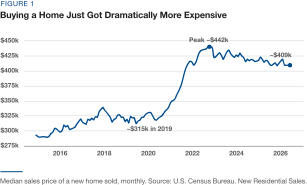
First, home prices climbed (Figure 1). According to Census Bureau data, the median new home sold for approximately $315,000 in 2019; it peaked near $440,000 in 2022 and still runs about $410,000 as of the most recent available data. Second, the cost of financing a purchase rose sharply as interest rates climbed off their pandemic lows — so the monthly cost of buying rose even faster than the sticker price.
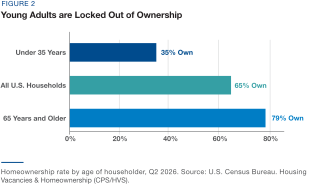
The result: buying is increasingly out of reach for younger households. Census data indicate that homeownership among adults under 35 — the prime first-time-buyer years — is currently around 35% (Figure 2), versus roughly 79% for those 65 and older, and about 65% for U.S. households overall. Priced out of buying, more young households rent — and rent for longer.
Meanwhile the country keeps forming new households — Census Bureau estimates indicate more than a million additional households were formed in a single recent year — and rental demand has kept the national homeownership rate stuck around 65%. Many of those new households would once have become buyers. Today a growing share stay renters, adding steady demand to the apartment market.
The Supply Spigot is Running Dry
Recent construction data tell a more nuanced story than headline completion figures suggest. Yes, a lot of apartments were built recently. But that was the tail end of a building boom launched when money was cheap in 2021 and 2022. Those projects are finishing now. What matters for the future is what is being started today, and that pipeline is thinner.
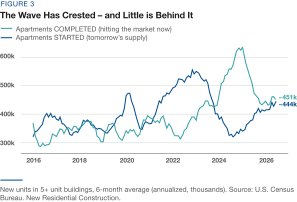
Figure 3 tracks two things: apartments being completed (units hitting the market right now) and apartments being started (tomorrow’s supply). The completion wave crested near a multi-decade high and is now rolling over. Behind it, new starts sit well below the 2022–23 peak.
Building an apartment community takes two to three years. So the pullback in starts could translate into fewer new apartments delivered over the next two to three years. As the current wave of supply is absorbed and less is built behind it, the balance between supply and demand may tighten, which historically has supported rents and occupancy.
Why Higher Rates Created an Opening
This is where the investment case comes together, and this section defines one key term: the capitalization rate.
Real estate investors talk about the capitalization rate, or “cap rate.” It is simply a property’s annual income divided by its price — the rough yield you would earn buying it with cash. It is the mirror image of the stock market’s price-to-earnings ratio: a higher cap rate is like a lower P/E — you pay less for each dollar of income. That income figure is net operating income (NOI), the rent collected after a building’s operating expenses.
When interest rates rose sharply, two things happened to apartment buildings: financing got more expensive, and buyers demanded higher yields to compensate. Both push prices down. A building that sold at a rich price (a low cap rate) in 2021 generally has to offer a higher cap rate — a lower price for the same income — to sell today. As of mid-2026, the 10-year Treasury yield, a key benchmark for these decisions, has been hovering around 4.6%.
Illustrative example: A building earning $1 million in NOI that sold for $25 million (a 4% cap rate) in 2021 might trade closer to $20 million (a 5% cap rate) today — the same income, a lower price, and a higher going-in yield for the buyer.
For an owner who bought at the top, that repricing was painful. But for an investor putting money to work now, it may represent an opportunity: the potential to buy sound, well-located apartment communities at prices — and starting yields — that were not available a few years ago, in some cases below what it would cost to build the same property new.
Converging on the Multifamily Moment
We believe the current apartment market may reflect a convergence of favorable conditions over roughly the next two to three years (through 2027–2028):
- • Demand is strong. The current affordability gap between owning and renting is keeping a growing share of Americans in the rental pool.
- • New supply is thinning. The recent construction wave has crested and is now rolling over, and the pipeline behind it is smaller, pointing toward a tighter market.
- • Prices have reset. Higher interest rates repriced assets, creating entry points with an apparent relative margin of safety versus 2021–2022 valuations.
Apartments have long offered what many portfolios want: income that tends to keep pace with inflation (leases reset every year), plus the potential for the property itself to appreciate. And investors do not have to become landlords to participate. Beyond owning buildings directly, they can invest through real estate investment trusts (REITs) — companies that own income-producing property and pass most of their income through to investors. REITs come in publicly traded and non-traded forms, and a range of private funds offer other routes in.
Market conditions can shift. If interest rates stabilize and sentiment improves, prices may adjust. Investors who recognize favorable conditions early may be better positioned for the potential benefits of income today and appreciation tomorrow.
Key Takeaways
- • The typical new home now costs roughly a third more than before the pandemic, and only about 35% of adults under 35 own a home — keeping more Americans renting for longer.
- • The recent apartment-building wave crested and is now rolling over, while new construction starts sit below their peak, pointing to slower supply growth ahead.
- • Higher interest rates have reset apartment values from their 2021 highs, creating entry points and starting yields that compare favorably to recent history.
- • Repriced assets, steady renter demand, and a thinning supply pipeline may present favorable conditions for investors evaluating multifamily opportunities.
Sources
The data referenced in this piece is based on publicly available U.S. government sources, including those listed below. Readers should refer to the original sources for the most current and complete data.
- • U.S. Census Bureau — New Residential Sales (median sales price of new homes): census.gov/construction/nrs
- • U.S. Census Bureau — New Residential Construction (apartment starts & completions, 5+ unit buildings): census.gov/construction/nrc
- • U.S. Census Bureau — Housing Vacancies & Homeownership, CPS/HVS (homeownership by age, homeownership rate, rental vacancy, household counts): census.gov/housing/hvs
- • Board of Governors of the Federal Reserve System — H.15 Selected Interest Rates (10-year Treasury constant maturity): federalreserve.gov/releases/h15
Charts were generated using data from the public sources above. Data as of mid-2026 unless otherwise noted.
Important Disclosures
This commentary has been prepared by Cantor Fitzgerald Asset Management (CFAM)* for use with investors and financial advisors who are each expected to make their own investment decisions. Nothing contained herein should be treated as investment advice or a recommendation to buy or sell any security. The information contained herein is for educational and informational purposes only.
Nothing herein shall constitute tax advice; investors should consult their own tax adviser regarding the tax consequences of their investment activities.
This commentary discusses general market activity, industry or sector trends, or other broad-based economic, market, or political conditions and should not be thought of as research or investment advice. This material has been prepared by CFAM, is not a research product, and was not produced by Cantor Fitzgerald & Co. The views and opinions expressed may differ from those of Cantor Fitzgerald and its affiliates. Any illustrative examples are hypothetical, do not represent any specific investment, and are provided solely to explain concepts.
Certain economic and market information contained herein has been obtained from or generated using published public sources prepared by U.S. government agencies. While such sources are believed to be reliable, neither CFAM nor its parent or any affiliates, employees, or representatives assumes any responsibility for the accuracy, completeness, or timeliness of such information or any AI-generated output derived from it. Market indices are included only to provide an overview of wider financial markets and should not be viewed as benchmarks or directly comparable to CFAM portfolios. It is not possible to invest directly in an index.
The information in this presentation is subject to change without notice, and we have no obligation to update it, whether as a result of new information, future events, or otherwise.
Certain statements in this commentary may constitute forward-looking statements, including statements regarding market trends, supply and demand conditions, and investment opportunities. Forward-looking statements are subject to risks and uncertainties, and actual results may differ materially. These statements reflect views as of the date of this publication and CFAM undertakes no obligation to update them.
Past performance or targeted results is no guarantee of future results, and an investment may lose money. Investors should consider the investment objectives, risks, charges, and expenses of the investment strategy before investing.
CFAM used the assistance of artificial intelligence (AI) tools in preparing this document. AI output may contain errors, omissions, or outdated information. Although all AI-generated content is reviewed by CFAM personnel prior to publication, CFAM does not guarantee the accuracy or completeness of any AI-generated output.
Cantor and the Cantor logo are trademarks or registered trademarks of Cantor Fitzgerald Securities or its affiliates existing from time to time in the U.S. and/or other countries. Other trademarks appearing herein are the property of their respective owners.
Cantor Fitzgerald refers to Cantor Fitzgerald, L.P., its subsidiaries, including Cantor Fitzgerald & Co., and its affiliates including BGC Group, Inc. (NASDAQ: BGC) and Newmark (NASDAQ: NMRK).
*CFAM is a brand of Cantor Fitzgerald referring to the entities and business lines collectively comprising its asset management business.